In a city where concrete and status dominate, a few mud houses quietly challenge what we think we know about life, community, and success. Laughter, curiosity, and muddy hands tell a different story — one that asks us to pause, reflect, and reconnect with our roots. What can simple living teach us about who we are and how we belong?
Soooo…..once upon a time, in 2006, I built my first mud home, in the midst of humongous houses in a leafy suburb just outside of Nairobi. These houses were a reasonable size, and a family of three lived in one of them.
As my mud homes were going up, I had no end of curiosity…with some neighbours, I could see ‘thinking’ I had finally completely lost it!!!! I remember a friend came over with a newly married young couple, and as I engaged in conversation with the newlyweds, I happened to mention that I was planning to build more mud homes as B&Bs. I saw the look on the new wife’s face as she said indignantly…’ I could never live in a mud house. Hmmm…. I thought….
The other two became classrooms for a children’s holiday school, where they learned about their African heritage, which covered a wide range of topics. Sadly, I felt, not many children had ever been to their ’shags’, or entered a house built of mud, let alone seen or touched a cow! Milk came from a supermarket. I wondered how many ‘urbanite’ children play outside with mud, grass and make their own entertainment ‘things’.
Children had a lot of very interesting questions, and I had to break a lot of misconceptions through pictures and my life experiences. The misconceptions they had of anything made of mud as ‘homes’ and toys, rural lifestyle and the people living in these rural environs were mostly negative. I couldn’t help but notice that there was an attitude of ‘we are superior’ to those upcountry, because of what ’we have’ and they ‘don’t’. We talked about the benefits of mud houses, also known as cob in the West, the cost of building and the different designs. By the end of the day, children were so much more informed and aware of mud houses. We need to give our children
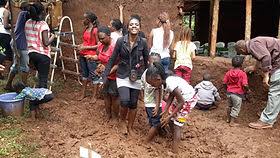
At the end of the holiday school, we made mud and grass houses. The children loved every minute of this outside play, and many didn’t want to go home! They left covered in mud with big smiles on their faces. It was a joy to see them so happy.
Children’s attitudes towards others are very telling of the things they hear from their adult role models, and spending time with them was an eye-opener. This experience with the children made me wonder just how many parents expose their children to the ‘other side’ of their inheritance. Are we proud of our inheritance? Or have we closed our eyes to where we came from?
Hmmm….
Returning to Who We Are — Together
And in those muddy hands and laughter-filled moments, something deeper was unfolding — a quiet reminder of Ubuntu: I am because we are.
When children reconnect with the earth, with heritage, with one another, they rediscover belonging. They learn that life is not built only with cement, screens, and status — but with community, humility, shared stories, and respect for where we come from.
The discomfort some adults feel toward “mud houses” is not really about soil — it is about how far we have drifted from our roots. Many are caught in the design and development of stone houses – that’s development.
All this is not about asking you to run back to the rural environs to build yourself a mud home. No, it’s about remembering where you have come from. Not looking down on those who live in these homes. Our African ancestors built these homes with amazing traditional skills, alongside the community.
UBUNTU teaches that a person is shaped by community relationships, not by money, possessions or power. That dignity does not come from what we own, but from how we live together. And when we lose connection with our origins, we also lose something of our humanity and ourselves as a people. This is extremely evident in our society.
Perhaps the real question is not whether we could live in a mud house. But whether we can relearn how to recognise and appreciate where, as a people, we came from. Let’s take pride in our African roots.
And this story is not from the past alone.
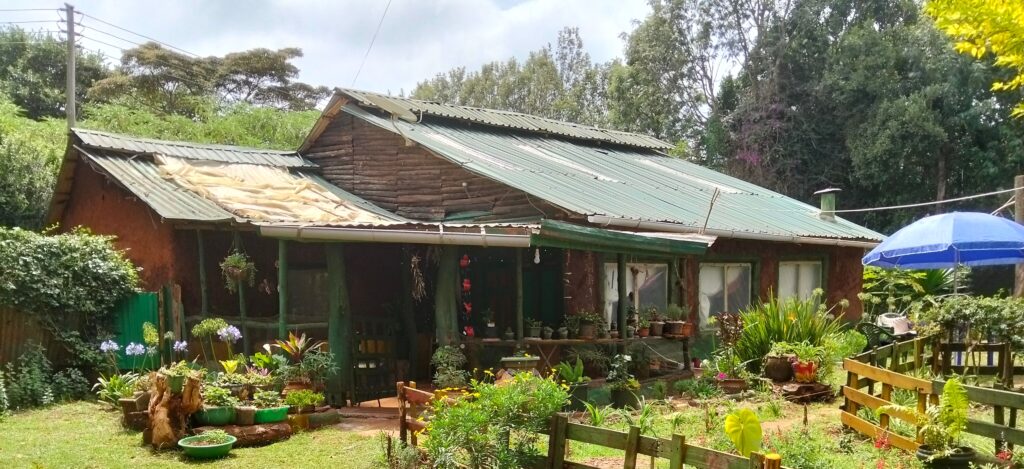
Today, I live in an earthen home — yes, right in one of the plushest suburbs just outside Nairobi. In a place known for concrete walls, high fences, and symbols of “arrival,” I chose soil, simplicity, and peace. Not because I could not afford otherwise, but because I discovered that life is richer when it is lighter, quieter, and rooted.
This home has become more than a shelter. It is a daily reminder that we do not need to abandon our heritage to progress. That modern life does not have to mean disconnected life. And that healing — for individuals, families, and communities — often begins when we slow down and return to what truly gives life. Perhaps the future we are searching for is not ahead of us in endless striving, but behind us in wisdom we once knew — now reimagined for today.
“Stand at the crossroads and look; ask for the ancient paths, ask where the good way is, and walk in it, and you will find rest for your souls.” — Jeremiah 6:16
For more, visit:
Self-build a Mud Home with a Twist.
https://dtearthgardens.wixsite.com/dtearthliving/ushago-homestead-construction
Ushago Down2Earth Retreat Home
Karen. Nairobi. Kenya
https://shiberoa.wixsite.com/shiberoscobandb